

Types of Needle Roller Bearings and How to Choose the Right One for Your Industry

Types Of Needle Roller Bearings And How To Choose The Right One For Your Industry

The wrong bearing specification doesn’t announce itself on day one. Instead, it surfaces weeks later as unexpected downtime, a premature failure, or a costly line stoppage. That is the exact risk that engineering and procurement teams manage daily. So, getting this decision right is critical.

When an application demands high radial load capacity within a tight envelope, needle roller bearings are the definitive solution. Their slender, high-strength rollers deliver a load density that standard bearings cannot match. 

At VM Traders, we have spent over four decades helping engineers and buyers specify the right bearing for every application. Not the closest option. Not the most available one. The right one.

This blog walks you through every major needle roller bearing type, what sets each one apart, and how to choose the right one for your application. 

A] What Is a Needle Roller Bearing?

Basic Definition and Design

A needle roller bearing uses cylindrical rollers whose length is at least three times their diameter. That slim geometry gives it a very low cross-sectional height, making it the right call when radial space is tight, but load requirements are still demanding. They also come with or without inner rings, giving you the flexibility to choose exactly what your application calls for.

How They Differ from Standard Roller Bearings

The smaller roller diameter in needle bearings allows more rollers to fit within the same envelope, resulting in higher radial load capacity for a given cross-section. The trade-off: more internal friction at elevated speeds compared to ball bearings.

B] Types of Needle Roller Bearings and Their Key Characteristics

Understanding the different types of needle bearings is the first step to making the right purchase decision.

Blog 1

1] Drawn Cup Needle Roller Bearings (Shell Type)

These have a thin-walled outer ring and are deep-drawn from sheet steel. They come in open-ended and closed-ended variants with two sub-types:

  • Caged (e.g., HK Series):
    Rollers are held in a cage for smoother rotation and are primarily designed for moderate-to-high-speed applications.
  • Full Complement (No Cage):
    Maximum rollers are packed into the bearing to achieve the highest radial load capacity, making them ideal for low-speed, high-load conditions.

Applications: Automotive transmissions, power tools, chain drive sprockets, and small electric motors.

2] Machined (Solid) Needle Roller Bearings

A thick, precision-machined outer ring offers superior resistance to shock loads, overloads, and misalignment compared to drawn cup bearings, making it suitable for crankshafts and other demanding applications.

These bearings are available with or without inner rings:
NK/NKS (without inner ring) and
NKI/NKIS (with inner ring).

Applications: Heavy machinery, hydraulic pumps, steering gear, and agricultural equipment.

3] Needle Roller and Cage Assemblies

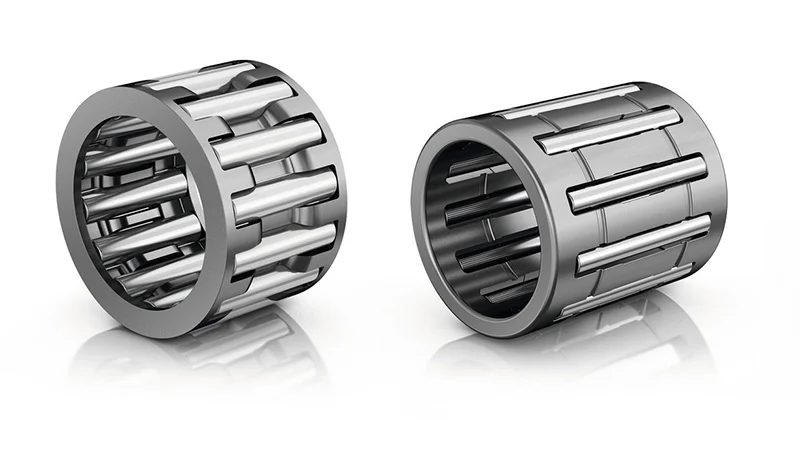
These bearings have no outer ring, allowing the shaft and housing bore to act directly as raceways. A cage keeps the rollers evenly spaced, ensuring effective lubrication and smooth operation at higher speeds. This is the most compact needle bearing option when radial space is extremely limited.

Applications: Planetary gear sets, gearboxes, and automotive drivetrains.
Blog 1 2

4] Thrust Needle Roller Bearings

Designed for axial loads rather than radial, these are paired with hardened thrust washers that act as the raceway surfaces. Here is what is impressive: they take up no more space than a plain washer yet deliver far better load capacity and significantly lower friction. 

Applications: Automatic transmissions, torque converters, and axial positioning in machine tools.

5] Cam Followers and Track Rollers

These are specialised needle bearings built for applications where the bearing itself rolls against an external surface, following cam profiles or running along tracks. The heavy-duty outer rings are there for a reason: they handle the high contact stresses of continuous surface contact. 

Applications: Conveyor systems, printing machines, textile machinery, and robotics.

6] One-Way (Freewheel) Needle Roller Bearings: HF Series

These needle roller bearings let the shaft spin freely in one direction, then automatically lock when rotation reverses. The rollers wedge between the inner and outer rings under reverse load.

Applications: Conveyor backstops, indexing mechanisms, packaging equipment, and overrunning clutches.

Choosing the right bearing can be tough. Let our team find your perfect match

Speak to Our Expert →

C] How to Choose the Right Needle Roller Bearing: A Buyer’s Checklist

1] What type of load are you dealing with? Needle roller bearings handle radial loads by default. For axial loads, specify a thrust needle roller bearing or a combination of both if loads act in multiple directions. 

2] How much radial space do you have? Drawn cup bearings and cage assemblies offer the most compact footprint. Machined (solid) bearings need more room but handle heavier, more demanding conditions.

3] What are your speed requirements? Caged bearings suit moderate-to-high speeds. Full complement bearings (no cage, maximum rollers) are better for slow, heavy-load applications.

4] Is there any shaft misalignment? If yes, machined (solid) bearings handle it far better than shell-type or cage assemblies, which require precise alignment.

5] Do you need an inner ring? If the shaft is hardened and ground to the required finish, it can act as the inner raceway directly, saving space. If not, specify a bearing with an inner ring (NKI/NKIS series) to protect the shaft.

D] Why Choose VM Traders for Needle Roller Bearings?

1. You Need More Than Just a Catalogue Supplier

The real risks in bearing procurement aren’t hard to list:

  • Incorrect specifications
  • Long wait times
  • Counterfeit products

Any one of these can stop production.

For over 40 years, VM Traders has been built around eliminating exactly these three risks for engineers and procurement teams across India.

2. The Right Bearing, First Time

Our team doesn’t just process orders—they help match the right needle roller bearing type to your exact load, speed, and space requirements. All products are sourced from Schaeffler, IKO, and Tsubaki , along with a curated selection of additional brands, backed by full authenticity certification and complete supply chain traceability.

3. Stock Depth That Matches Your Urgency

Our Mumbai showroom maintains ready inventory across a wide range of needle roller bearing types and series. Bulk supply is available for OEM buyers and procurement teams, helping eliminate long lead times for standard requirements. Feel free to call us or send an enquiry to receive a specification recommendation—not just a quote.

Explore our full inventory of high-speed cylindrical and tapered roller bearings

Browse Bearing Catalogue →

Conclusion


Choosing the right needle roller bearing type is more than a technical decision—it directly impacts your costs, equipment uptime, and overall operational efficiency. Selecting the correct specification from the outset helps prevent premature failures, costly downtime, and unnecessary replacement expenses.

Browse our full range of needle roller bearings or send us a bulk enquiry today. Our experienced team will recommend the right bearing specification for your exact application, ensuring reliable performance and long-term value.

Frequently Asked Questions

Think of a needle bearing as a roller bearing that works smarter, not bigger. It uses long, thin cylindrical rollers where the length is at least three times the diameter. The bearing can carry heavy radial loads without needing a bulky cross-section, making it a compact solution for doing a heavy-duty job.

You will find them in automotive transmissions, gearboxes, power tools, hydraulic pumps, agricultural machinery, and precision machine tools. They are ideal anywhere you need to support heavy loads in a tight space.

These are individual needle rollers used without a cage or rings, with the shaft and housing acting directly as the tracks for the rollers. This design packs in the maximum number of rollers to handle the highest possible loads, but it is best suited for low-speed applications.

Needle bearings are ideal for when radial space is tight but loads are heavy and the motion is either moderate-speed or rocking back and forth. You can also use them for when the shaft acts as the inner track, saving you from a total redesign.

Replace them immediately if you notice unusual noise, increased vibration, or rising operating temperatures. For high-stakes machinery, it is always smarter to replace them during scheduled maintenance before they fail.

Leave A Comment