

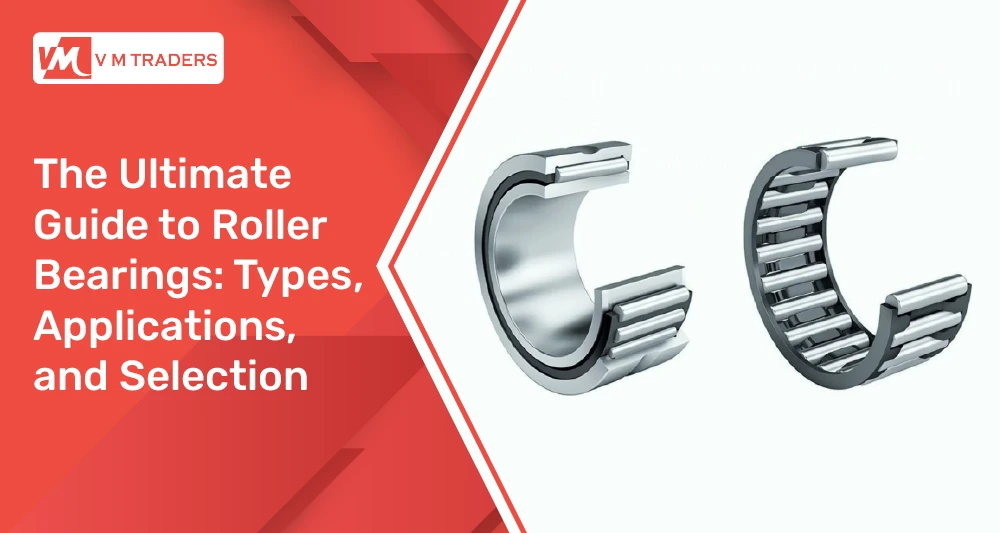
Industrial machinery and heavy vehicles all rely on bearings for continued operation. Roller bearings handle load, speed, and stress. But if you fit the wrong one, you risk overheating, premature wear, and unplanned downtime, all of which cost much more than the bearing itself.
As authorised bearing distributors in Mumbai since 1982, we’ve created this guide on roller bearing types and applications to help you make the right choice.
Table of Contents
ToggleA] What Is a Roller Bearing, and What Is It Used For?
A roller bearing reduces friction between stationary and rotating components by placing rolling elements (cylindrical, conical, or needle-shaped) between an inner and outer raceway. These elements roll rather than slide as the shaft turns, reducing heat production and increasing component life.
Line contact gives roller bearings significantly higher dynamic load capacity than a comparably sized ball bearing, making it the preferred choice wherever loads are heavy, sustained, or multi-directional. You will find them in axles, gearboxes, wheel hubs, conveyor systems, hydraulic pumps, and steering assemblies across India’s industrial sectors.
B] Types of Roller Bearings
| Bearing Type | Load Type | Speed | Alignment Tolerance | Key Application |
| Cylindrical roller | Radial | High | Low | Gearboxes, electric motors |
| Tapered roller | Radial + axial | Moderate | Low | Axles, wheel hubs |
| Spherical roller | Radial + moderate axial | Moderate | High (self-aligning) | Mining, heavy conveyors |
| Needle roller | High radial (compact) | Moderate-high | Low | Hydraulic pumps, steering columns |
| Thrust roller | Pure axial | Low-moderate | Low | Crane hooks, drilling rigs |
| Cross roller | Radial + axial + moment | Low-moderate | Low | Robotics, precision machinery |
1. Cylindrical Roller Bearings
Cylindrical bearings use straight rollers parallel to the shaft axis, delivering high radial load capacity through line contact. The separable ring design simplifies installation. Best for gearboxes, electric motors, and machine tool spindles. Not designed for axial loads.
2. Tapered Roller Bearings
The bearing uses conical rollers whose axes converge at a common point, enabling simultaneous radial and axial load handling. They are best for axles, wheel hubs, and crane pivots, but make sure the bearings are mounted in opposing pairs.
3. Spherical Roller Bearings
The bearing uses barrel-shaped rollers within a spherical outer raceway, self-aligning to absorb shaft deflection and housing misalignment. Best for mining equipment, heavy conveyors, and paper mill rolls.
4. Needle Roller Bearings
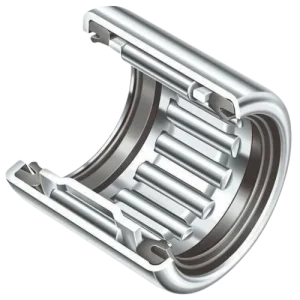
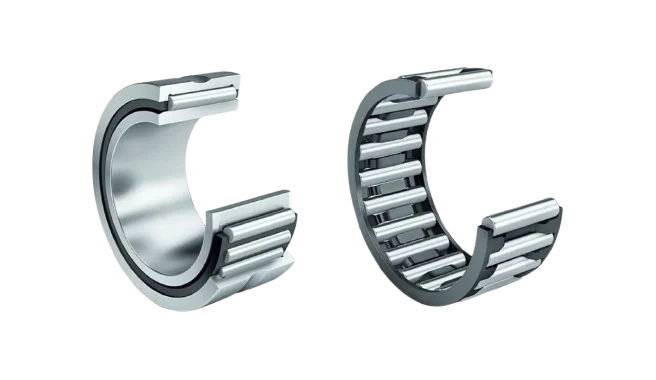
Needle bearings use very thin rollers (length-to-diameter ratio typically 3:1 or greater) to deliver high radial load capacity in a minimal cross-section. Best for hydraulic pumps, steering columns, and transmission components where space is critical.
5. Thrust Roller Bearings
The bearing carries axial loads along the shaft axis using rollers perpendicular to the shaft. Best for crane hooks, vertical shafts, and drilling rigs. They are not designed for radial loads, but you can pair them with a radial bearing for combined-load applications.
6. Cross Roller Bearings
The bearing holds combined loads in a compact unit by arranging cylindrical rollers at alternating 90-degree angles. Ideal for CNC rotary tables, robotic joints, and precision handling equipment.
Upgrade Your Machinery with High-Capacity Precision Components
Explore Needle Bearings →C] Roller Bearings vs. Ball Bearings?
The decision comes down to one core trade-off: load capacity versus rotational speed. Get this wrong, and you’re either over-engineering at unnecessary cost or under-specifying and watching components fail ahead of schedule.
Roller bearings are the right call when:
- Loads are heavy and sustained
- The application involves radial, axial, or combined forces
- Long service life under demanding conditions is a priority
- The equipment runs in heavy vehicles, manufacturing lines, or industrial machinery
Ball bearings are the right call when:
- Operating speeds are high, and loads are light
- The application demands precision and low friction
- Space and weight constraints favour a smaller, lighter component
D] How to Choose the Right Roller Bearing
- Load type: Cylindrical for pure radial. Tapered for combined radial and axial. Thrust roller for pure axial. Cross roller where moment loads are present. Always verify that your operating load does not exceed the bearing’s dynamic load rating as specified by ISO 281.
- Speed: Cylindrical roller bearings handle high speeds best. Tapered and spherical types suit moderate velocity. Thrust types are rated low-to-moderate only.
- Space: Where radial clearance is severely restricted, needle roller bearings are the only viable option without a redesign.
- Alignment: Use spherical roller bearings if the shaft deflects under load. Any rigid bearing fitted into a misaligned assembly will fail early and can damage surrounding components.
E] Why Sourcing from a Certified Distributor Matters
Counterfeit and substandard bearings are a documented problem in the Indian market. They fail to meet published load ratings and dimensional tolerances, making them unsafe.
At VM Traders, we’ve been selling industry-certified bearings from brands like Schaeffler (INA), FAG, IKO, EZO, and MNB since 1982. Every bearing we supply is genuine and fully traceable to the manufacturer.
We even provide pre-sales technical support, helping you confirm the right specification before it goes into your equipment, not after it fails.
Maximise your radial space and load capacity with engineered precision.
Request a Quote →Conclusion
Every roller bearing type is designed to solve a unique engineering challenge. The key is ensuring an exact match between your bearing selection and your application’s real-world load and alignment conditions. By combining this precise technical alignment with the absolute assurance of a certified, traceable distributor like VM Traders, you guarantee that your equipment will perform reliably and exactly as intended.Frequently Asked Questions
These bearings do two things: keep friction in check and carry heavy loads. That load can be radial, axial, or both. They are used in axles, gearboxes, conveyor systems, hydraulic pumps, and steering systems.
The answer really depends on the application. Roller ones are a better choice for environments involving a lot of heavy work. Meanwhile, ball bearings perform well in high-speed operations.
Spherical roller bearings are the clear choice. Their self-aligning design absorbs angular errors without transmitting stress to adjacent components. This makes them ideal for mining equipment, heavy conveyors, and similar applications where maintaining perfect alignment is not always practicable.
Heavy vehicles generate a lot of force across axles, wheels, and gearboxes. Roller bearings are more effective in distributing those loads than ball bearings. So, heavy vehicles rely on rollers to deliver greater load capacity and for a longer service life.
Cylindrical bearings are made for radial loads at higher speeds. They offer a separable design that simplifies installation. Tapered bearings handle both radial and axial loads simultaneously. However, you need to mount them in opposing pairs to manage forces in both directions.