

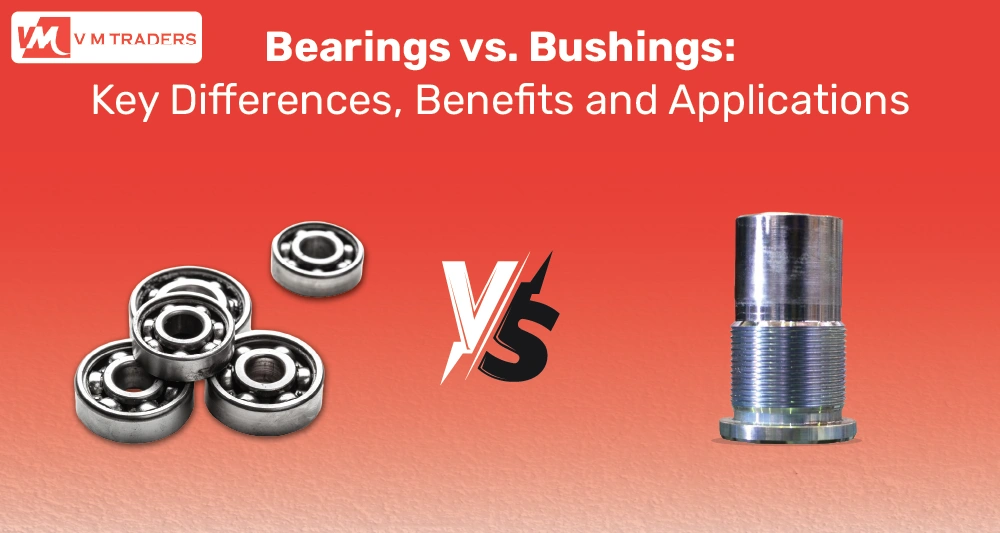
The tiniest parts can make the most impact when it comes to maintaining a smooth-running machine. The selection of the friction-reducing element is directly related to equipment efficiency, reliability, frequency of maintenance and operating costs.
Bearings and bushings are two popular solutions. Both have the purpose of alleviating friction and assisting movement but work on different principles and with different advantages.
However, there is no “best” answer, which you should choose. It entirely depends on your specific application, which we will discuss in this detailed blog post.
Table of Contents
ToggleThe Engineering Principles That Set Bearings and Bushings Apart
1. Rolling Contact vs. Sliding Contact
The primary difference between bearings and bushings is the way they minimise friction. In a bearing, the moving parts are separated by rolling elements such as balls or rollers. This rolling motion reduces friction within the system, making bearings suitable for high-speed and precision applications.
Bushings, however, operate through sliding contact between the bushing and the journal surface. They typically use a smooth surface and may be lubricated or self-lubricating. While sliding contact creates slightly more friction than rolling contact, bushings offer greater shock absorption and durability in demanding operating conditions.
2. Design Characteristics That Define Their Capabilities
Bearings generally have a more complex construction, consisting of an inner ring, outer ring, rolling elements, and cages. This design enables high precision and efficient operation, but proper alignment and maintenance are important for reliable performance.
Bushings have a simpler design and are typically made as cylindrical sleeves from materials such as bronze, plastic, or composite alloys. Their straightforward construction makes them easy to install, cost-effective, and robust. These design differences also influence where they perform best: bushings are generally well suited to dirty or demanding environments, while bearings are often preferred for clean, controlled, and high-speed applications.
Bearings vs. Bushings: A Practical Performance Comparison
1. Side-by-Side Performance Comparison
| Performance Factor | Bearings | Bushings |
| Load Capacity | High, particularly for combined radial and axial loads | Moderate to high under steady, non-shock loads |
| Speed Capability | High, suited to high-RPM operation | Lower, better suited to slow or oscillating motion |
| Friction | Low | Moderate, higher than rolling contact |
| Precision | High, tight tolerances for accurate positioning | Moderate, adequate where positioning is less critical |
| Wear Resistance | Good with proper lubrication, drops fast without it | Strong, especially with self-lubricating or composite liners |
| Shock Absorption | Limited, vulnerable to impact loading | Strong, tolerates shock and misalignment well |
| Lubrication Requirements | Regular, in most configurations | Minimal to none in self-lubricating designs |
| Maintenance | Higher, scheduled relubrication and monitoring | Lower, particularly maintenance-free variants |
| Service Life | Long, under correct load and lubrication | Long under steady load, shorter at high speed |
| Cost | Higher upfront | Generally lower upfront |
2. Interpreting the Results
This comparison highlights the difference between bearing and bushing clearly. Bearings prioritise speed and precision, while bushings focus on durability and simplicity. If your application demands accuracy and minimal friction, bearings are the better choice. However, if you’re dealing with heavy loads, contamination, or shock, bushings may outperform bearings. Ultimately, bearing vs bushing which is better, depends entirely on operating conditions rather than a universal standard.Not sure which one fits your application? Get expert guidance from VM Traders.
Talk to an ExpertMatching the Right Component to Your Application
1. Applications Where Bearings Are the Better Choice
Speed, accuracy and efficiency are key requirements in the many applications where bearings are used. Common applications include:- Electric motors
- Pumps and compressors
- High-speed rotating systems
- Machine Tools & CNC Machinery
2. Applications Where Bushings Excel
Bushings are suitable for use in environments with less predictable conditions and are used in heavy-duty and rugged applications. These include:- Construction equipment
- Mining machinery
- Agricultural equipment
- Applications that use oscillating or low-speed motors
3. Can Bearings and Bushings Work Together?
For some modern machines, bearings and bushings are not mutually exclusive. Hybrid systems are strategically combined, such as using bearings to spin and bushings to pivot loads. This can combine the strengths of both components to optimise performance, minimise wear and enhance machine efficiency.Making the Right Choice Starts with the Right Supplier
Choosing between a bearing or a bushing does not only involve knowing the technical difference, but also matching the component to actual operating conditions. Performance and life depend on a variety of factors including load type (static or dynamic), rotational speed, exposure to dust or moisture, and ease of maintenance. When it doesn’t match, it can result in early wear, unexpected downtime, and higher costs of operation.
The use of genuine and quality parts guarantees a uniform performance level and minimises the risk of failure in challenging applications. Most importantly, an experienced supplier will be able to give you advice on the application; which type, material and configuration best suits your equipment requirements.
A reliable partner doesn’t merely provide products, they assist you in making your decision. The right supplier provides long term value to your operations from recommending the right solution for your machine tools & CNC machinery, to ensuring product availability when you need it.
VM Traders, having more than 40 years of industry experience, has become a trusted stockist of bearings and bushings from world-class brands. They offer businesses in India top-notch technical support, expertise, and product range to optimise machine performance and minimise downtime. Call VM Traders today for the perfect solution to your application.
Genuine bearings and bushings, in stock and ready to ship.
Browse ProductsFrequently Asked Questions
A bearing reduces friction with rolling elements, balls or rollers, moving between the two surfaces. A bushing reduces friction through a sliding sleeve of low-friction material instead, with nothing rolling at all. That one difference in contact type is what drives nearly every other gap between the two, in speed, in precision, and in how much maintenance each one needs.
Sometimes. Where speed and precision needs are moderate, and where shock tolerance or contamination resistance matters more than raw speed, a bushing can do the job just fine. In high-speed, high-precision work, a bushing usually cannot match what a bearing delivers, and swapping one for the other without checking the load and speed rating first is a common way premature failures happen.
It depends more on the environment than on the component itself. A bearing under correct load and consistent lubrication can run for a genuinely long service life, but that number drops sharply the moment lubrication gets neglected, which happens more often than maintenance schedules would suggest. A self-lubricating bushing frequently outlasts a bearing in dirty or poorly maintained settings, precisely because it was never depending on a relubrication schedule that nobody was actually following.
On upfront cost, generally yes. Bushings are simpler to manufacture and do not demand the same manufacturing precision, which keeps unit cost down. Total cost of ownership can tell a different story, though. A bushing forced into the wrong high-speed job can need replacing often enough to erase whatever it saved on day one.
As a rough guide, bearings suit higher-speed work carrying a relatively steady load where real precision matters. Bushings suit slower or oscillating motion where shock loading, contamination, or irregular load direction outweighs raw speed as a concern. Either way, the manufacturer's datasheet for the specific part should confirm exact load and speed ratings before anything gets finalised on a drawing.