

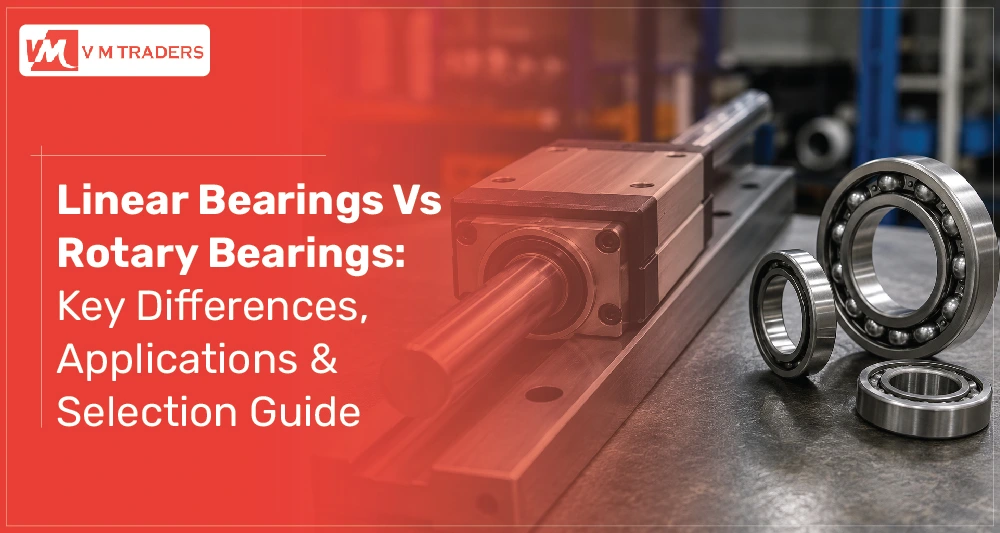
Every moving part in a machine relies on one thing to keep working smoothly – a bearing that manages friction and guides motion accurately. But not all motion is the same, meaning some components travel in a single line, while others spin. Getting the wrong bearing can lead to premature wear, positioning errors, or a machine that never quite performs as designed.
To help you make the right choice between linear and rotary bearings, our team at VM Traders has created this guide that breaks down how these parts work and compares their features.
First, let us see how each of these bearings works.
Table of Contents
ToggleA] Understanding Linear and Rotary Bearings
1. Linear Bearings?
A linear bearing keeps a machine part moving in a straight line instead of spinning. As the part travels, the bearing slides or rolls with it. This reduces friction and keeps the motion smooth and precise.
Some linear bearings use small balls that roll along the rail for maximum speed and accuracy, while others use simpler sliding bushings that aren’t quite as precise but hold better in dusty or dirty conditions. You’ll find them doing the heavy lifting in CNC machines, 3D printers, and robotic arms that pick up and place items.
2. Rotary Bearings?
A rotary bearing supports components that spin, letting them turn smoothly with very little resistance. It works by having an inner ring rotate inside an outer ring, with friction-reducing elements sitting in between.
The ideal choice simply depends on your load requirements. Standard ball bearings effortlessly handle everyday rotational loads, whereas heavy-duty roller bearings are specifically designed to manage high-load misalignment. They are mainly used in motors, gearboxes, pumps, and vehicle wheel hubs.
B] Linear Bearings vs Rotary Bearings: Key Differences
Choosing between the two comes down to matching the bearing to the motion. Here’s how they compare on the factors that actually matter when you’re specifying parts for a machine.
| Parameter | Linear Bearings | Rotary Bearings |
| Motion Type | Straight-line (translational) | Rotational |
| Load Handling | Transverse loads perpendicular to travel | Radial, axial, or combined loads |
| Precision | High positioning accuracy over a fixed stroke | High rotational accuracy at varying speeds |
| Speed | Limited by stroke length and travel rate | Can sustain very high rotational speeds |
| Maintenance | Depends on travel distance; needs periodic relubrication | Rated in operating hours (L10 life); interval varies by load and speed |
These differences shape real-world performance. A linear bearing forced to carry an axial load will wear out fast, since that force is meant to be absorbed by a ball screw, belt, or cylinder. Meanwhile, a rotary bearing pushed into straight-line travel will bind and fail quickly. The two are simply not interchangeable, no matter how similar they look on a parts shelf.
Get the Exact Component You Need to Keep Your Operations Moving Smoothly
Contact Our Traders →C] How to Choose Between Linear and Rotary Bearings
Once you know which type of motion you’re dealing with, a few practical factors narrow down the exact specification:
- Match the load type: Figure out which direction the force is pushing on the bearing and how heavy that load is. Undersizing for the actual load is one of the most common causes of early failure.
- Think about speed and how often it moves: High-speed rotation needs rotary motion bearings with good thermal and lubrication management. Meanwhile, high-cycle linear applications need bearings that can handle high travel distances.
- Set the accuracy grade: Machines like CNC tools or robots move in repeated patterns, so they call for a higher-precision bearing. For less demanding jobs, a standard bearing works fine and costs less.
- Account for footprint: In tight, compact machines, smaller designs (like needle rollers or flanged units) can still carry the required load without taking up extra room.
D] Choosing the Right Bearing Supplier
Picking a type is only half the job; the right supplier determines whether that spec actually holds up in the field. Here’s what to look for:
- Genuine, Correctly Rated Products: Counterfeit or mismatched bearings fail faster and cost more in downtime. We supply genuine bearings that meet the required specifications for reliable performance and longer service life.
- Technical Guidance: A good supplier checks your load rating, fit tolerances, and sealing/lubrication needs against the actual application to help you select the right bearing.
- Ready Stock: When a production line can’t afford to wait, having a bearing partner that supplies quickly matters as much as having the right specification. Our ready stock helps minimize downtime and keep your operations running smoothly.
VM Traders has supported industries across India for over four decades as a trusted bearing dealer in Mumbai, offering a comprehensive range of linear and rotary bearings from globally trusted brands. From precision linear bearings to rotary bushes for demanding industrial shafts, our team offers the application support needed to get the specification right the first time.
Partner With a Supplier That Understands Precision
Get Bearings→Conclusion
Linear and rotary bearings are engineered for different jobs: one guides straight-line motion. Meanwhile, the other supports rotation. Neither is better than the other; they simply serve different purposes within a machine.
Before you choose, take a good look at your load, speed, and precision requirements. If you need help picking the right one, feel free to reach out to our team.
Frequently Asked Questions
A linear bearing guides a component along a straight path with minimal friction, keeping motion smooth and accurate. It’s commonly used in CNC axes and automated equipment where parts need to travel back and forth precisely.
A rotary bearing supports rotating shafts and components, allowing them to turn smoothly while carrying radial, axial, or combined loads. It’s the standard choice in gearboxes and wheel assemblies.
Linear bearings cost more because making them requires precision-ground shafts or rails, tight manufacturing tolerances, and hardened materials for durability, all of which add to the price.
Beyond straight-line guidance, linear bearings reduce maintenance downtime through simple relubrication cycles, allow easy replacement without disturbing the shaft or rail, and support modular machine design since carriages can be added along the same rail for multi-axis setups.
Rotary bearings are available in a far wider range of sizes and load ratings than linear bearings. They also tolerate higher operating temperatures in sealed or shielded variants and are generally more cost-effective for standard radial or axial applications.